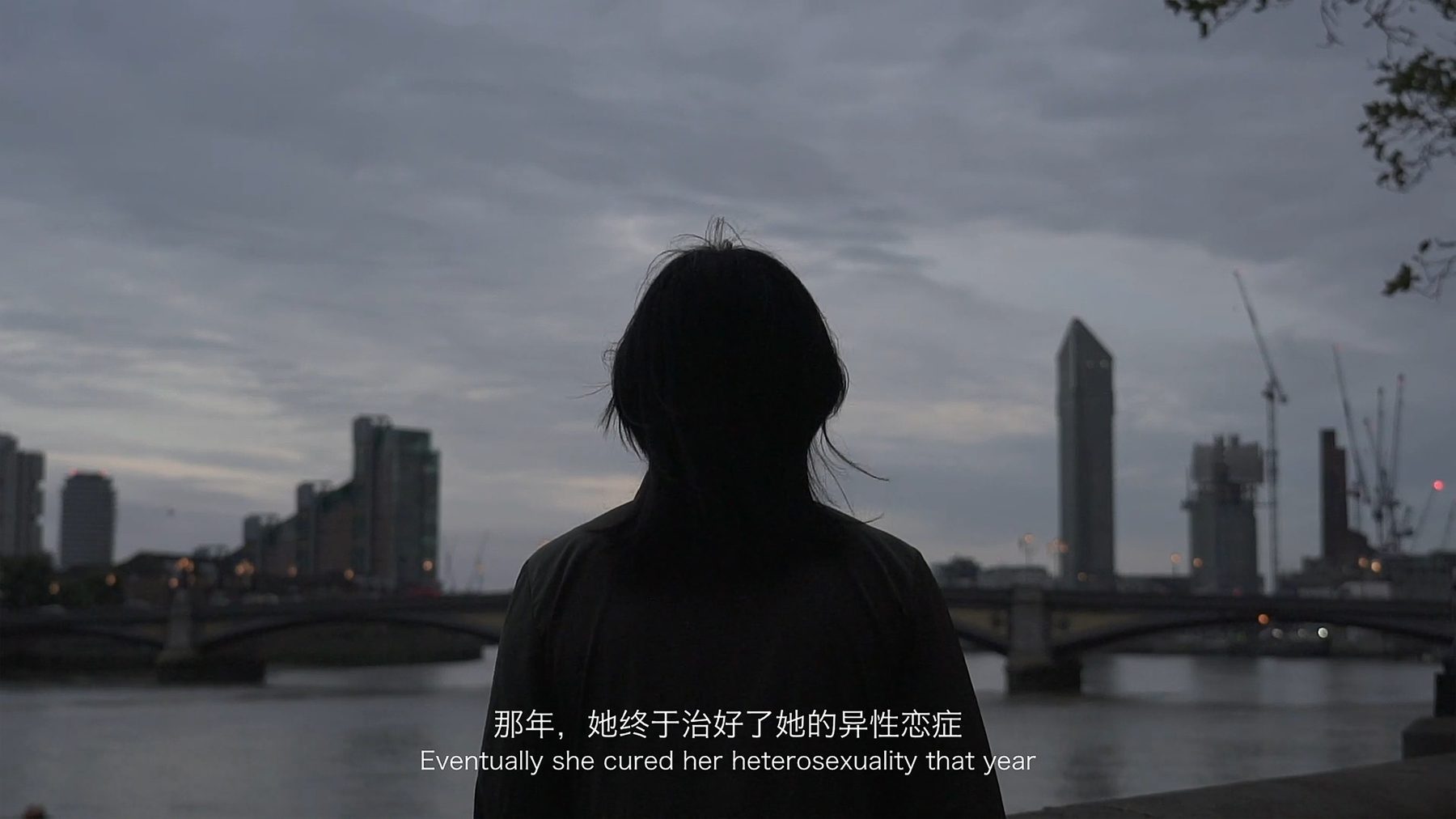
Eventually She Cured Her Heteronormativity That Year responds to Taiwanese gay poet Kehua Chan’s poem Male Danube, which describes a gay man’s emancipation from heterosexuality through a mixture of relief, loss, and estrangement. Although I found myself unexpectedly resonating with the poem’s emotional landscape, this sense of affinity was soon interrupted by my frustration with the poet’s misogynistic remarks. The work emerges from this conflicted position: a simultaneous identification with queer liberation and a sharpened awareness of the exclusions and violence that can persist within it.
In the video, I rewrite Chan’s poem as a feminist response, reflecting the confusion, impact, and solitude brought about by a newly awakened feminist and gender consciousness. Feelings of association, frustration, isolation, and loss are whispered into the subtle movements of river, breeze, and light. The work presents an ambivalent confrontation with heteronormativity: not as a moment of clear liberation, but as an uneasy process of self-reflection, disillusionment, and reorientation.
At the end of the video, A Song to Encourage Feminism (1907), written by Chinese revolutionary and feminist pioneer Qiu Jin (1875–1907), is played. Its presence frames the work within a longer, unfinished feminist lineage, while also encapsulating the loneliness and unease of awakening—like the figure who has stepped out of Plato’s cave, unable to return to what once seemed natural, yet uncertain of how to inhabit the light.